
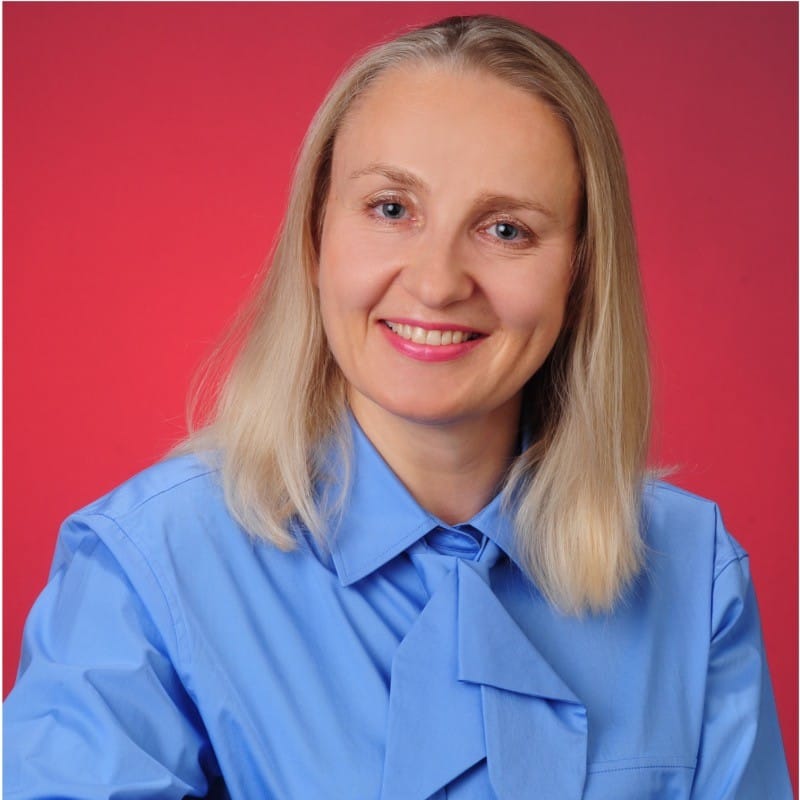
Lidia Wiśniewska
Role of Interest:
President (2-year term)
LinkedIn Profile:
https://www.linkedin.com/in/dr-lidia-wiśniewska-리디아-위스니에프스카-3037a818/
Motivation: Please describe your motivation for pursuing this role and the qualifications you would bring to it.
My motivation is simple: theory and practice in the intercultural field cannot be separated, and SIETAR Europa needs leadership that holds both together. My background – from doctoral research to an Erasmus Mundus diploma in internationalisation – taught me that real competence is built in encounter, not in frameworks alone.
That is how I see SIETAR Europa: not as a professional association among others, but as an educational space where people are genuinely changed by what they learn and who they meet. This demands that we model what we teach. Each SIETAR was created to carry its own regional richness – not to transmit frameworks top-down, but to cultivate what is genuinely rooted in its own context.
SIETAR Europa has the reach to make that richness visible and shared – but this flows in both directions: a stronger Europa enriches its national SIETARs, and stronger national SIETARs enrich Europa. That interdependence is our greatest asset.
In SIETAR Polska we are building a community of reflective practitioners. In SIETAR France I helped stabilise governance and co-organised events. These experiences taught me that institutional and professional trust is built slowly, and lost quickly.
This is the work I want to do.
Vision: What is your vision for the future of SIETAR Europa? What priorities would you set in order to achieve that vision?
My vision is grounded in a question we rarely ask aloud: why do we call ourselves SIETAR Europa? The name carries a promise we have not yet fully kept. Europe has its own philosophical roots of encounter — the multilingual Rzeczpospolita, the convivencia of Al-Andalus, the ethics of Levinas, the hermeneutics of Gadamer. These are not decorative references. They are the foundation of a distinctly European understanding of the Other – one that is older, and in some ways deeper, than the frameworks we have imported without always questioning their origins.
My vision is to make SIETAR Europa a space where diversity is lived, not declared – where traditions from Central and Eastern Europe, Southern Europe, and beyond are no longer underrepresented. Where conversation is genuinely possible across disagreement. The world outside is changing fast. SIETAR Europa has important role to play in intercultural discourse.
My priorities: a Congress that meets our diversity and moves our community forward; a united collaboration between the Board and Executive Committee; and bringing the intellectual richness of our national SIETARs into shared conversation across Europa.
Growth: How would you propose increasing membership numbers, enhancing membership value and ensuring the long-term relevance of SIETAR Europa to its members?
Membership growth requires value that cannot be found elsewhere. I would propose three concrete directions.
First, an integrated academic and practitioner community — peer-reviewed working papers, a dedicated SIETAR Europa research series, and partnerships with universities across Europe, including Central and Eastern Europe (CEE) institutions currently absent from our network. Researchers, educators, and trainers should work together, not in parallel tracks. Members should feel that SIETAR Europa makes them sharper – not through generic diversity toolkits, but through resources grounded in genuine theoretical depth and real practice.
Second, a CEE and Southern European expansion strategy – these are the fastest-growing intercultural markets in Europe, with vibrant national chapters ready to bring new members if given genuine institutional support rather than symbolic inclusion.
Third, long-term relevance through intellectual courage — having a voice in public debate on the intercultural dimensions of migration, AI, and geopolitical change, international relations where our expertise is needed most.
Leadership: SIETAR Europa relies on the energy of volunteers. How would you lead and support others in their roles to prevent burnout and ensure organizational effectiveness and continuity?
Leading a volunteer organisation requires a particular kind of realism – the willingness to plan for human limits without being defeated by them. My approach is founded on three principles.
First, redundancy by design: every role needs at least two people who understand it, so that no single departure breaks continuity. This is not distrust – it is respect for the reality that lives change.
Second, honest recognition: volunteers sustain their energy when their contributions are named specifically and publicly, not thanked generically. I would build a culture of explicit acknowledgment – not certificates, but genuine visibility.
Third, development as retention: people stay when they feel they are growing. I would ensure that every SIETAR Europa volunteer role offers something in return – learning, professional environment, connection to a wider community of practice.
My experience leading SIETAR Polska taught me that the President’s task is not to carry the organisation but to create conditions in which others carry it with pride. That requires listening more than speaking, and asking what someone needs before telling them what to do.
Commitment: Serving on the Executive Committee requires both leadership competence and hands-on time commitment (about 5–10 hours of active work per week). To what extent do you have the flexibility in your personal and professional roles to make this time available?
I will be direct: this role requires genuine time, and I take that seriously. As a Research Professor at CENTRUM Católica/PUCP with a flexible academic schedule, and based in France at the heart of European networks, I have structural capacity for this role. I currently hold the presidency of SIETAR Polska, the vice-presidency of SIETAR France, board membership at SIETAR Europa — while maintaining an active research agenda and meeting all deadlines.
This is not a boast; it is evidence of how I work. Each of these roles has built competence that directly serves SIETAR Europa: national chapter leadership, institutional governance, research rigour, and direct knowledge of this organisation’s terrain. The result is not someone who needs time to learn the landscape — but someone who already knows it. Five to ten hours per week is manageable within my current structure. If elected, I would reorganise my commitments to protect focused time for SIETAR Europa. I would not accept a role I could not honour. What I bring is not only availability, but informed, purposeful energy.